
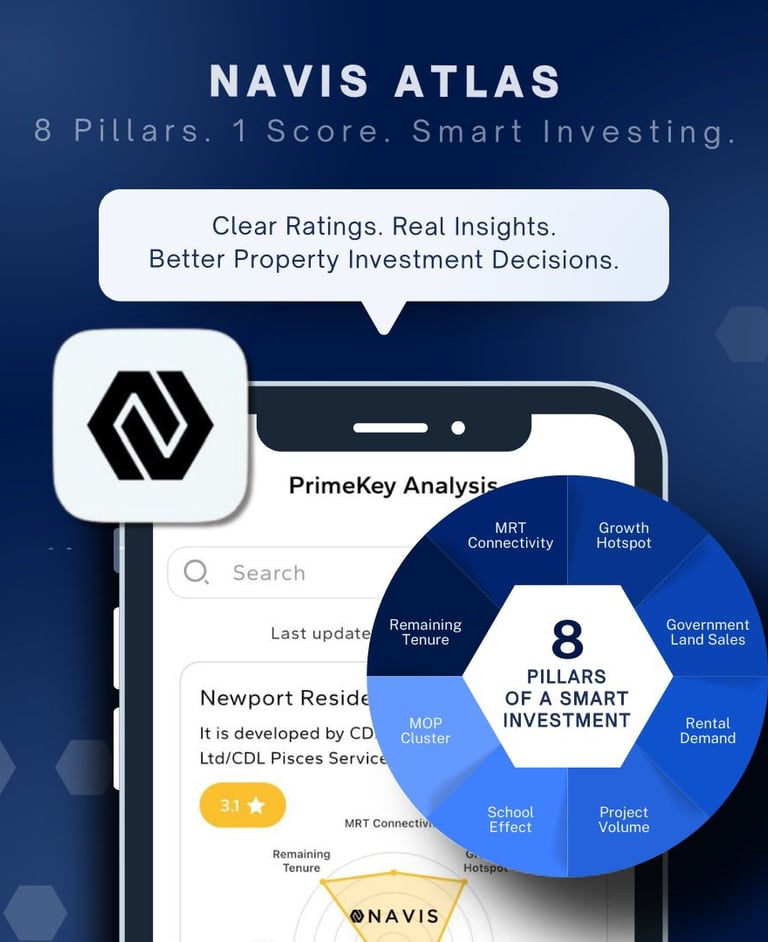
What is PrimeKey Analysis?
PrimeKey Analysis is a core feature of the Navis Atlas app, offering an objective investment framework powered by 8 proven real estate performance factors. By converting decades of collective property expertise into a single, transparent score, it allows users to instantly compare over 3,000 projects across Singapore.
Move past gut-feeling and make property decisions driven by data-backed clarity.
The 8 Essential PrimeKeys
Each factor directly targets a core buyer or investor priority:
Proximity to MRT: Better transport access expands your tenant and buyer pool.
Remaining Lease: Newer properties traditionally maintain and grow value more effectively.
HDB Upgrader Demand: A larger local upgrader pool fuels stronger future resale demand.
Future Land Sales: Nearby new launches at higher price points elevate surrounding values.
URA Growth Hotspots: Capitalizes on long-term government urban planning and appreciation.
Project Size (Total Units): Scale provides better amenities, liquidity, and market recognition.
Area Rental Yield: A vital metric for cash-flow and income-driven investors.
Primary School Access: A major catalyst for family buyers and sustained owner-occupier demand.
While these concepts are simple on their own, together they form an all-in-one property decision matrix.
The 8 Critical Factors—And Why Each One Matters
Backtested data from the Singapore market shows that these 8 factors consistently drive long-term property performance. Because no single metric tells the whole story, they are assessed together to give you a complete picture.
Factor 1: MRT Connectivity Walking distance to an MRT station is a top predictor of property performance. Units within 500m consistently outperform those past 800m in both capital growth and rental yield. More than just convenience, it ensures a massive, diverse pool of buyers and tenants, giving you excellent liquidity and pricing power when you sell.
Factor 2: URA Masterplan Growth Hotspots Properties in or near URA-designated growth corridors (like Jurong Lake District, Woodlands Regional Centre, or Tengah) historically see higher price appreciation. The secret is entering these zones early, capturing growth before active development drives prices up.
Factor 3: Government Land Sales (GLS) Pipeline Future GLS releases near a project can briefly pause local prices as buyers wait for new options. However, over the medium term, they inject new infrastructure and amenities that lift the entire neighborhood's value. We model the GLS pipeline within 1km to project its impact on your investment timeline.
Factor 4: Project Size and Liquidity Larger developments (400+ units) enjoy healthy transaction volumes. This creates a steady stream of price benchmarks and a larger pool of active buyers. Conversely, smaller boutique projects can carry liquidity risks, especially if multiple owners try to sell at the same time.
Factor 5: Remaining Lease and Tenure A critical, often overlooked risk. 99-year leasehold properties generally hit a three-stage lifecycle: growth (years 1–30), stagnation (years 30–60), and decline as the lease shortens. Once a lease drops below the 60-year threshold, future buyers face CPF usage restrictions, which severely narrows your exit market.
Factor 6: Rental Yield Benchmarking High rental yield is a strong signal of tenant demand. When a development beats its district's average yield, it attracts both cash-flow investors and owner-occupiers, ensuring a healthier resale market. We benchmark each unit to ensure its yield is sustainable, not artificially inflated.
Factor 7: Nearby Primary Schools Being within 1km of a branded primary school is one of Singapore’s most recession-proof demand drivers. Families consistently seek out these registration zones, creating predictable, cycle-resistant demand—particularly for 3-bedroom units and larger.
Factor 8: HDB MOP Upgrader Demand Neighborhoods with a high concentration of HDB flats reaching their Minimum Occupation Period (MOP) create a natural pool of affluent, aspirational buyers. Areas with a wave of flats hitting MOP over the next 2–3 years provide a reliable demand floor that protects your property from downside risks.
How the Scoring Works in Practice
Every property is evaluated across all 8 factors and given a score from 0 to 8 based on how many pillars it successfully ticks. A score of 6 or above highlights a high-conviction asset backed by multiple structural demand drivers—the kind of property that thrives in any market condition, not just a boom.
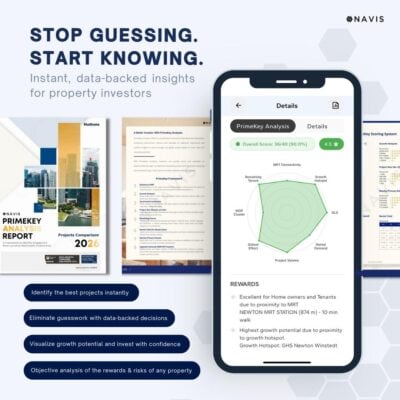
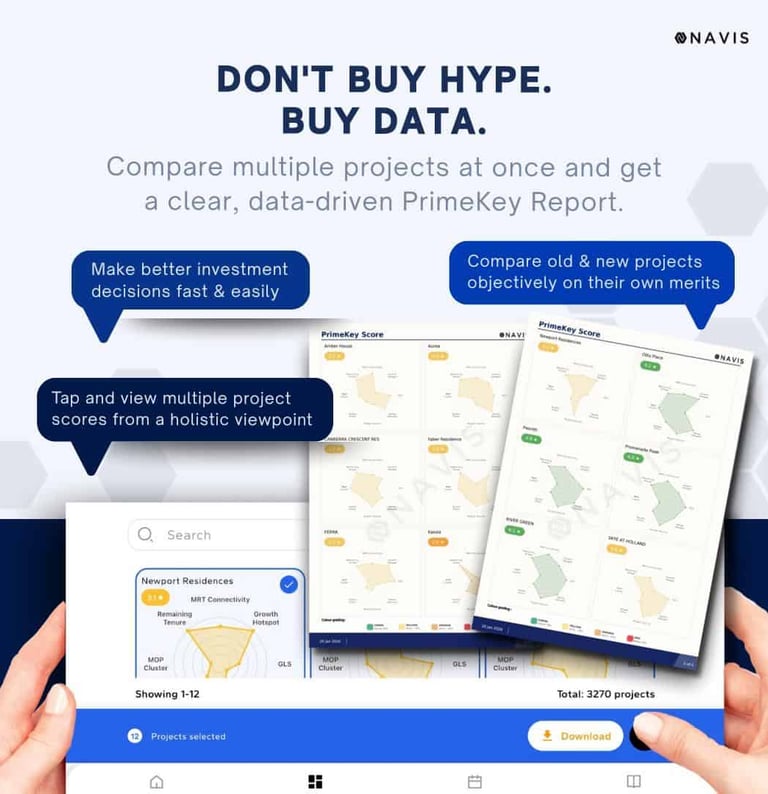
Inside Your PrimeKey Comparison Report
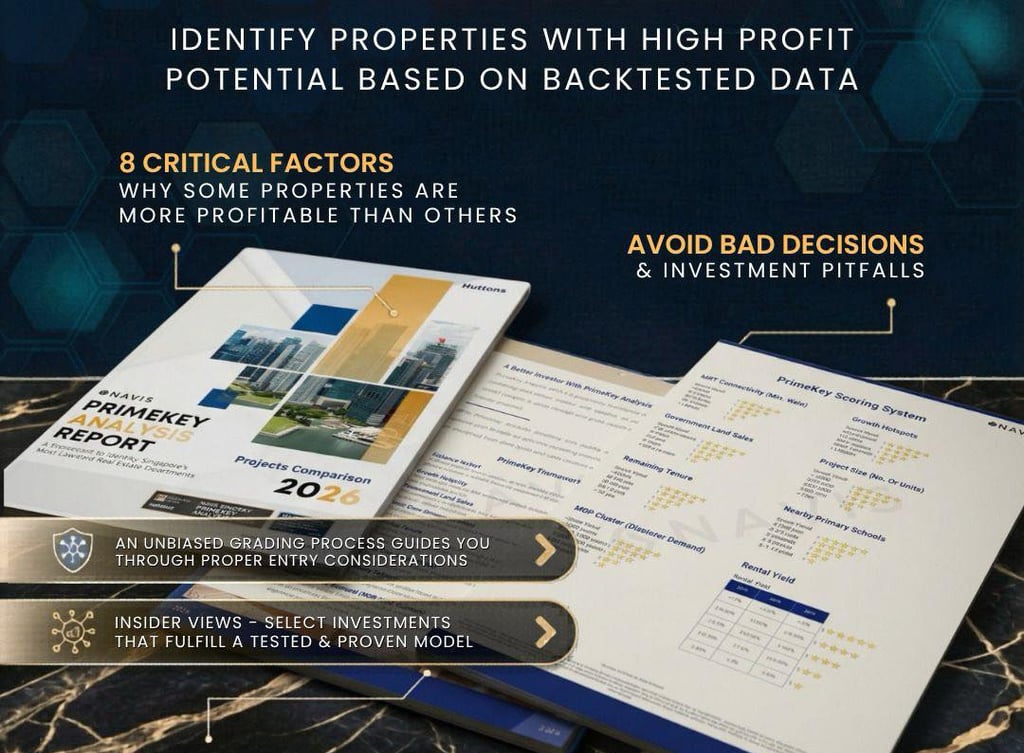
Every analysis delivers an in-depth evaluation combining visual data, granular factor breakdowns, and actionable insights designed to give you total investment confidence.
Visual Radar Chart: View your overall PrimeKey Score at a glance.
8-Factor Deep Dive: Get a detailed breakdown of every underlying growth driver.
Side-by-Side Comparison: Evaluate multiple properties simultaneously for clear benchmarking.
Interactive Location Mapping: Analyze nearby amenities and geographic advantages.
Investment Potential Assessment: Review data-backed growth projections and risks.
Target Audience Profiling: Discover the most likely future buyers for the asset.


Think Freehold always beats a 99-year leasehold?
The data might say otherwise. 📊
In District 28, High Park Residences (99-year) massively outperformed Serenity Park (Freehold) with a ~62% capital appreciation versus ~38%, despite entering the market in the same year and at roughly the same price! 🤯
How did the leasehold win?
As shown in image 2, Freehold only secured them one pillar.
High Park won on three major fronts: doorstep MRT/LRT connectivity, massive project size for liquidity, and a huge MOP exit audience.
Remember: Tenure is just a floor, not an engine! 🚀
There are 8 crucial pillars that determine a property's growth potential.
Curious how your property scores across all 8 factors?
Or looking for your next data-backed investment? DM me to see how our free PrimeKey report can give you the clarity you need. 📈
📥 DM me "ATLAS" if you're looking to buy!
📥 DM me "HEALTH CHECK" if you already own & want a check up on your property!
#Navis #SingaporeProperty #FreeholdVsLeasehold #PrimeKeyAnalysis #PropertyWealthPlanning


Property Health Check
Your condo scored well in 2019. Would it still pass today? 📊
Many homeowners assume that if they bought a fundamentally strong property, it stays that way forever.
But real estate data isn’t static.
4 major pillars move on their own—without a single brick in your condo changing:
⏳ HDB MOP Demand: Rolling 5-year upgrader pools naturally empty out over time.
🏗️ GLS Plots: Past price-setting catalysts become new, finished competition.
📉 Lease Clocks: Crossing under 90 or 85 years progressively impacts bank financing and liquidity.
📍 Growth Catalysts: Once infrastructure is built, future upside is fully priced in.
Don't wait for your future buyer to point out what's changed.
👉 DM me "HEALTH CHECK" to get a zero-obligation PrimeKey™ audit on your private property today.
#SingaporeProperty #PropertyWeathPlanning #NavisAtlas #PrimeKeyAnalysis #PropertyHealthCheck
What if you had PrimeKey back in 2011?
Back then, the market looked at Punggol and saw "oversupply."
But the data told a different story: a price floor had just formed. 🧱
The moment new land was awarded 20–40% higher, older projects like A Treasure Trove became drastically undervalued. 💎
📋 The Result — A Treasure Trove, 2011 Scorecard:
* 🏆 39/40 across eight growth pillars. Near-perfect scores on MRT Connectivity, GLS/Enbloc potential, Rental Yield, and more. ⭐
* 🏷️ Entry: ~$900 psf
* 💰 Today (Aug 2026): ~$1,616 psf
* 📈 Result: ~77–80% capital appreciation. Gross profit on a 3BR: $750,000+ 🚀
⚠️ The reality check: A high score doesn't guarantee explosive growth. 💡
Timing, macro forces, and sentiment still matter. 🌍 But what a high score does is anchor your decision in fundamentals. ⚓
It protects your downside 🛡️ — and lets the upside take care of itself. 📈
PrimeKey strips out the noise so you invest on data, not hype and hope.
🗺️ 2,800 projects. One decisive score. Zero guesswork.
👀 Which of today's launches are hiding in plain sight?
Get your free, no-obligation PrimeKey report:
* Buying? 📩 DM me "ATLAS" 🗝️
* Already own? 📩 DM me "HEALTH CHECK" 🩺
#SingaporeProperty #PropertyWeathPlanning #NavisAtlas #PrimeKeyAnalysis #PropertyHealthCheck


Otto Place
Otto Place: 38/40 🏢✨
Project Overview: Executive Condominium | 99-year lease (from 2024) | By Hoi Hup Sunway Plantation | Completing 2029
Run on the PrimeKey Investor Lens—where all eight pillars are weighted equally with zero profile bias—Otto Place comes back at 38/40.
That’s 95%, placing it comfortably inside the Excellent Match band (35 and above). 📈🎯
Here is exactly what gets measured, every time, on every project:
* 🚇 MRT connectivity
* 🗺️ Growth hotspot proximity
* 🏗️ GLS / En-bloc activity (within 2km)
* 💰 Rental yield (for its market segment)
* 🏢 Project size
* 🏫 School effect
* 🏘️ MOP cluster
* ⏳ Remaining tenure
No hype, no fluff, and no "exciting opportunity" buzzwords.
Just eight numbers and a score you can actually benchmark against. 📊
Want the same run on the condo you're eyeing?
📩 DM "ATLAS" for a complimentary PrimeKey report.
Note: A PrimeKey score is a fundamental research and shortlisting tool, not financial advice. It does not cover price, valuation, or unit-level attributes. ⚠️
#Huttons #PrimeKeyAnalysis #OttoPlace #NavisAtlas #PropertyInvestment #SGPropert


The Quinn vs Park Colonial
Bartley/Woodleigh, 2018:
Freehold vs New Launch 🏙️
Two condos.
Diagonally across the road from each other.
The Quinn
* Freehold, 2 years old
* ~$1,450 psf
* PrimeKey: 31/40
Park Colonial
* New launch, 99-year lease
* ~$1,730 psf
* PrimeKey: 39/40
The question every buyer asked:
Why pay ~$280 psf more for a leasehold when a nearly-new freehold is sitting across the road?
Fast forward eight years.
📈 The Quinn: ~$1,593 psf — +10%
📈 Park Colonial: ~$2,330 psf — +35%
For a 3-bedder, that’s roughly 3× the gross profit for the buyer who paid more upfront.
The value gap between them were real.
But so were the fundamental reasons behind it — and the scorecard could identify them back in 2018:
* 139 units — months can pass without a transaction, making it harder to establish strong recent comparables
* 750m to the MRT — versus Park Colonial’s more direct MRT connectivity
* Beside the Bidadari transformation — rather than being positioned within it
Freehold is one pillar out of eight.
It carries just 5 points out of 40.
It cannot carry a project that is weaker on scale, walkability and growth potential.
🎯 Cheaper is not the same as better value.
DM “ATLAS” for a free PrimeKey report on any condo you’re weighing up.
#SingaporeProperty #PrimeKeyAnalysis #PropertyWealthPlanning #NavisAtlas


ATLAS Health Check
Any condo can sound good, but a good project doesn’t automatically make it good for everyone. 🏢✨
PrimeKey cuts through the hype with eight measurable drivers—from MRT connectivity and rental yield to school effects and growth hotspots.
While PrimeKey Investor offers a neutral read, PrimeKey Profiles reweights those same pillars to match what you actually prioritize.
No vague claims. Just a clearer shortlist tailored to your goals.
* Buying? DM "ATLAS" for a complimentary PrimeKey report.
* Already own? DM "HEALTH CHECK".
#SingaporeProperty
#PrimeKeyAnalysis
#PropertyWealthPlanning
#NavisAtlas #Huttons


PrimeKey Profiles
Introducing PrimeKey Profiles - Another industry defining innovation by Navis. 🚀
Clients aren't all the same.
PrimeKey Profiles offers an industry 1st customized analysis for:
👵 Retirees
🔒 Privacy-focused buyers
💎 Luxury investors
🏠 HDB upgraders
👨👩👧👦 Couples with young kids
…and more!
Grade projects your way. We deliver insights according to your real needs. Shorten the selection process with precision matching. ✨
The future of real estate intelligence is personalized. 🎯
#NavisAtlas
#PrimeKeyAnalysis
#PrimeKeyProfiles


One Condo, Four Different Answers
The condo never changes. The right answer does. 🏢
Put four buyers in front of the same development, and they are running completely different maths:
* 👨👩👧 Young Family → School Effect is 35% of the decision
* 👫 Couple, no kids → GLS / Enbloc activity is 35%
* 🧓 Retiree → MRT connectivity is 35%
* 🏢 HDB Upgrader → Project size is 35%
Same eight pillars. Same objective star ratings on the building.
Completely different weighting — and very often, a completely different shortlist.
That weighting isn't a gut call.
PrimeKey Profiles uses Rank Order Centroid, a decision-science method that converts your priority rankings into exact weights (swipe to see how it works ➡️). Your #1 priority ends up carrying over 11× the weight of your last.
Most property advice is one-size-fits-all. Yours shouldn't be.
Comment or DM the profile that sounds like you, and we’ll run your customized PrimeKey Profile report for free. 📩
#SingaporeProperty
#PrimeKeyAnalysis
#PropertyWealthPlanning
#NavisAtlas #Huttons


ATLAS Scorecard
We put PrimeKey through a much bigger test. 📊
718 launches. Each tracked for 10 years.
Then we asked one simple question:
Did projects with better PrimeKey grades actually see better long-term growth?
The median 10-years results:
🟢 Excellent: +40.7%
🔵 Good: +30.8%
🟠 Fair: +22.5%
🔴 Poor: +6.8%
The ladder held — grade by grade.
That doesn’t mean every Excellent project will outperform every Good project. Property markets are never that neat.
But across hundreds of condo launches and very different market cycles, the relationship was clear: stronger PrimeKey fundamentals were associated with stronger 10-year outcomes.
That’s what PrimeKey is designed to do — not predict the future, but help buyers stack more of the important factors in their favour before they buy. 🔑
Less hype. More evidence. Better-informed property decisions.
DM “ATLAS” if you’d like to see the PrimeKey grade before you shortlist your next property. 🌟
#PrimeKeyAnalysis #NavisAtlas #NAVIS #SingaporeProperty #DataDriven #PropertyWealthPlanning #Huttons


Two Projects
Two projects. Same launch year. One gained 62%. The other lost 26%. 👀
This is why I don’t like telling clients to choose a property based on one headline feature like “freehold”, “near MRT” or “cheap entry price”.
The better question is:
How strong is the property across the fundamentals that actually support long-term demand and resale?
That’s where PrimeKey Analysis comes in. 📊
It helps me break down a project across key factors such as connectivity, growth drivers, future land supply, project size, tenure, schools, upgrader demand and rental yield — so we can compare properties on a more objective basis before making a decision.
In this 2007 backtest, the stronger-scoring project went on to produce a very different 10-year outcome from the weaker one.
Of course, past performance never guarantees future results and what I do isn’t to predict profits but to ensure fundamentals are strong for the property being shortlisted.
I would rather help clients identify the risks before they buy, then explain to them ten years later when it’s all too late. 🔑
If you’re currently looking at a new launch, resale condo or even comparing two properties on your shortlist, DM me “ATLAS”.
I can run a complimentary PrimeKey Analysis for you and show you where the strengths — and blind spots — really are.
#PrimeKeyAnalysis #NavisAtlas #NAVIS #SingaporeProperty #PropertyWealthPlanning #Huttons


Seascape
Imagine paying $2,683 psf for a luxury sea-facing home, only to see it drop -23.7% a decade later. 📉
It wasn't bad luck—the warning signs were hidden in plain sight.
Back in 2010, the launch appeared prestigious on the surface, but a data-backed breakdown revealed 7 out of 8 critical pillars scored 2 stars or lower:
❌ Poor MRT connectivity
❌ Weak hotspot momentum
❌ Limited exit liquidity
A single strong pillar (tenure) could not carry the weight of weak fundamentals.
Property decisions in Singapore shouldn't rely on hype, emotional brochures, or guesswork.
Whether you are planning to buy, sell, or hold, you deserve to know the real risk profile of your asset before making a multi-million-dollar move.
👉 DM me to get a complimentary PrimeKey Report on your target condo or current home today.
#SingaporeRealEstate #NavisAtlas #Navis #Huttons #PrimeKeyAnalysis #PropertyWealthPlanning


Is it a right buy?
A condo can look good on paper… but is it actually the right buy? 🏙️🔍
Price, tenure and location are only part of the picture.
With PrimeKey Analysis, we assess Singapore private condominiums across 8 growth factors to help uncover the strengths, weaknesses and potential blind spots that may not be obvious at first glance.
📊 One project. 8 growth factors. One decisive score.
🏢 2,800+ projects analysed
🔎 Built and used every day by the Navis team
And now, you can get a complimentary PrimeKey report for a property you’re considering — or one you already own.
Thinking of buying?
👉 DM “ATLAS” and tell us the condo you’re looking at.
Already own a property?
👉 DM “HEALTH CHECK” and find out how your property scores.
No obligation. Just more data, more transparency and more clarity before your next property decision. 🔑
Stop guessing. Start scoring.
#PrimeKeyAnalysis #Navis #NavisAtlas #SingaporeProperty #PropertyWealthPlanning #Huttons


ICON
Before ICON gained 173.8%, the fundamentals were already visible. 👀
Back in 2003, ICON at Tanjong Pagar would have scored 34/40 on PrimeKey Analysis — a strong Good grade.
What stood out?
✅ Excellent MRT connectivity
✅ Inside the Concept Plan 2001 growth story
✅ Large 646-unit development
✅ Healthy remaining tenure
✅ Strong MOP upgrader pool nearby
✅ Attractive estimated rental yield
It wasn’t perfect — the GLS/Enbloc pillar scored 3★ and the School Effect just 1★.
But that is exactly the point.
PrimeKey isn’t looking for a “perfect” property. It is looking for strong fundamentals, multiple demand drivers and fewer ways for the investment thesis to fail. 📊
Ten years later, ICON’s median PSF had risen from about $691 psf to $1,892 psf — a gain of 173.8%.
Of course, hindsight is easy.
The real question is:
Would you have been able to identify those strengths before the decade played out? 🔑
That’s what PrimeKey Analysis is designed to help with.
If you already have a condo on your shortlist, send it to me.
DM “ATLAS” and I’ll run a complimentary PrimeKey report for you.
Let’s look at the fundamentals before you commit.
Past performance is not a guarantee of future results. PrimeKey is a research and shortlisting tool, not financial advice.
#PrimeKeyAnalysis #NavisAtlas #Huttons #SingaporeRealEstate #PropertyWealthPlanning


CASPIAN VS OASIS
Two condos launched in the same year at similar entry prices — but 10 years later, one rose 82.2% while the other managed only 23.9%. 📈
Here’s the breakdown:
Caspian (2009)
🏆 PrimeKey Score:* 35/40 (Excellent)
💰 Price Movement:* $612 psf ➔ $1,115 psf (*+82.2%*)
🚶 MRT:* ~3–4 min walk to Lakeside MRT
🏢 Size:* 712 homes
📍 Growth Catalyst:* Near Jurong Lake District
Oasis @ Elias (2009)
📊 PrimeKey Score:* 28/40 (Good)
💰 Price Movement:* $658 psf ➔ $815 psf (*+23.9%*)
🚶 MRT:* 11 min walk to Pasir Ris MRT
🏢 Size:* 388 homes
📍 Growth Catalyst:* No nearby growth hotspot in 2009
---
⚖️ A 7-point score difference translated into a 58% profit gap.
Back in 2009, PrimeKey’s scoring framework already flagged Caspian’s edge in:
* Walking distance to MRT 🚆
* Proximity to major growth transformation 🌱
* Higher project scale & liquidity 🏙️
* Stronger rental yield profile 💼
That's the point of PrimeKey. It isn’t just about the launch psf — it’s about the setup behind the numbers.
📩 DM ‘ATLAS’ to get an objective PrimeKey score and report on your property shortlist before you buy.
---
#SingaporeRealEstate #PrimeKeyAnalysis #NavisAtlas #Huttons #PropertyWealthPlanning



Review the data first. Ask questions after.
Send us a note and we'll follow up with the relevant documentation for your property or market question—no obligation.
PrimeKey Analysis
(C) 2026 PrimeKey Analysis-Evidence-led property analysis for Singapore.